Wolfe's Angel
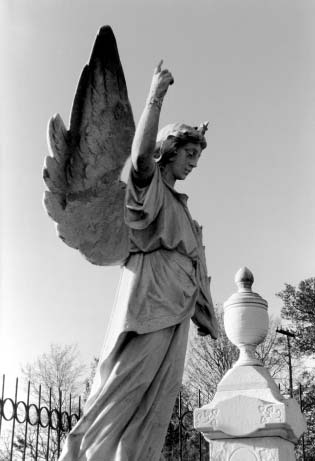
I lived in one of the fourth floor attic rooms of Mangum Dorm my freshman year at the University of North Carolina in Chapel Hill. It was a memorable year, of course, as all freshman years are wont to be. I struggled with calculus, was only mildly interested in chemistry, and was annoyed at the huge introductory courses in political science, anthropology and psychology. But I was amazed at the freedom I had.
Freedom to stay up late, walk around campus or downtown to Franklin Street at any time of day or night, and, of course, much more. Attending eight o’clock classes came to seem a physical impossibility. Sure, the alarm would go off but I would immediately fall back asleep and wake again only when the radio shut off after the thirty minute alarm mode expired. But my sleep deprivation wasn’t all because of late night socializing and beer tasting.
Many were the nights I was awake at 1:00 in the morning, sitting at my desk in my Mangum attic room, reading. But it wasn’t homework. Certain novels I stumbled upon simply swept me away—I hate to use the cliché, but I literally could not put these books down, and read them into the nights and early mornings. Kerouac’s On the Road.
John Barth’s The Sotweed Factor. Robert Penn Warren’s All the King’s Men, and Kesey’s Sometimes a Great Notion. Calculus and chemistry be damned, my need to remain in the worlds created by these novels was too great to be displaced by coursework or sleepiness. And maybe at the top of the list of these books that spirited me away my freshman year was Thomas Wolfe’s famous autobiographical novel of growing up in Asheville, Look Homeward, Angel.
Before it burned, I visited the boarding house in Asheville run by Wolfe’s mother and described at length in Look Homeward, Angel, called “My Old Kentucky Home.” At the time the keepers of the house had posted descriptions from the novel of various parts of the house at the described location within the house. The effect was remarkable—to read Wolfe’s words describing the staircase and then to look up at the actual staircase itself. Wolfe and his fictional counterpart from his novel, Eugene Gant, were also freshmen at the University of North Carolina—in Chapel Hill for Wolfe, and in “Pulpit
Hill” for Mr. Gant. As an undergraduate, many is the time I strode through Battle Park or Polk Place in their footsteps. It wasn’t until recently, however, that I learned of an important Look Homeward, Angel site that I’d never visited—the homeward looking angel itself.
Thomas Wolfe’s father was W.O. Wolfe (W.O. Gant in the novel) who made his living as a stonecutter and seller of tombstones. On the porch of the elder Wolfe’s shop in Asheville, Wolfe kept one or more carved marble angels that he had ordered from Carrara, Italy.
The stone angels apparently sat on the porch for years, unsold and staring off into the distance—making an impression on the youngest of W.O. Wolfe’s eight children—Thomas. Look Homeward, Angel contains several references and descriptions of a stone angel, resting for years on W.O. Gant’s porch, “poised clumsily upon the ball of one phthisic foot, and its … white face … [wearing] the look of some soft stone idiocy.” Wolfe’s angel is still with us.
Twenty-five miles south of Asheville (Eugene Gant’s Altamont) in Hendersonville is the Oakdale Cemetery—from downtown Hendersonville take Highway 64 west a short distance. You’ll see the cemetery and then on your left you’ll see a state historical marker which states: “Wolfe’s Angel: Marble statue from the Asheville shop of W.O. Wolfe inspired the title of son Thomas Wolfe’s Look Homeward, Angel.’ Stands 150 feet south.” Sure enough, just to the south is a wrought iron fence surrounding the grave of Margaret Bates Johnson. On a pedestal above the grave is a stone angel with raised arm and a beatific expression.
This is likely the angel that Thomas Wolfe knew well as a child, surely studying its expression and following its gaze as he passed by it on the porch of his father’s shop. But Hendersonville’s claim to Wolfe’s angel is not without a little controversy. It does seem probable that W.O. Wolfe imported several marble angels from Italy and that more than one may have lingered at his shop during Thomas’ youth.
There are reports that W.O. Wolfe lost one of his imported angels in a poker game and that this angel wound up on the grave of Hattie McCanless in the Old Fort Cemetery in Old Fort. And another of Wolfe’s angels marks the final resting place of Fannie Clancy in the Bryson City Cemetery. There are those that claim one of these angels was more likely the source of Thomas Wolfe’s inspiration.
So, go search out these stone angels, look into their eyes, try to read their expressions, and then turn away to look in the direction of their gaze. It’s what Thomas Wolfe must have done. And they all are looking towards home.