Into the Waccamaw
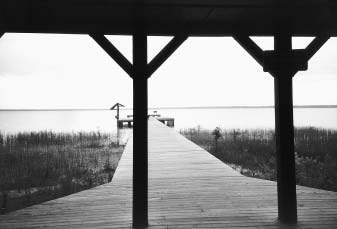
The air hanging over Lake Waccamaw is absolutely still. No movement ripples the water. The lake’s surface is a perfect reflection of the January sky. The air temperature is 46 degrees.
I see some sort of water bird silently flapping over the water near the southern shore. It disappears into the forest at the lake’s edge. There is no sound at all. I stand on the shore and gaze off into the distance.
For a time. It dawns on me. I’d like to make a wake in that clear still water sometime. To swim across the lake.
As I walk back to my car, I think to myself that I’ll write a letter. 18 January 2002 Lake Waccamaw State Park 1866 State Park Drive Lake Waccamaw, N.C. 28450
Dear Sir or Madam, I am a distance swimmer and I am interested in swimming across Lake Waccamaw. I believe there used to be an organized swim across Lake Waccamaw but it may have been discontinued several years ago. Can you tell me if there is any organized swim across Lake Waccamaw, either scheduled or to be planned? If not, would a swim across Lake Waccamaw be allowed?
I would expect to have several other swimmers and attendants in a boat accompany me on the swim, and to complete the swim responsibly and safely. If you would allow but discourage the swim I would appreciate knowing of your concerns. Thanks for your help and advice. Sincerely, Tom Fowler 68 January 25, 2002: No response yet from the Waccamaw State Parksters.
Didn’t expect any so soon anyway. But I did swim a mile and a half today in the pool. Waccamaw is like a four or five mile swim so I do need to get in some serious miles. Maybe thirty miles in January?
Columbus County’s Lake Waccamaw is five miles long and three miles wide—and shallow. It’s about eleven feet down at its deepest, and it averages maybe seven feet deep. Waccamaw is a spectacular example of a Carolina Bay. Carolina Bays are elliptical depressions in the earth spread out all along the east coast from Maryland to Georgia, although most are found in the Carolinas.
There are thousands of them (some say half a million). Many are small and many are now completely filled with vegetation. But some are still shallow lakes. In North Carolina’s Bladen County, Jones and Salters Lakes in Jones Lake State Park, and White, Bay Tree and Singletary Lakes in Bladen Lake State Forest, are also good examples of Carolina Bays.
February 5, 2002: All right. I have a letter from Lake Waccamaw State Park in my hands. If it isn’t an outright refusal, I bet it will discourage my proposed swim. I’ll bet.
Maybe I’ll just let the letter sit awhile before I open it. Then I open it. Dear Mr. Fowler: Thank you for your letter concerning your interest in Lake Waccamaw and swimming.
Lake Waccamaw is very popular for swimming and other water sports. Swimming to any extent in the Lake is allowed all year (weather is your option) round. It is very highly recommended that you have other swimmers accompany you any time that you are in the water and having close access to a safe watercraft while you are in the water is also a good precaution. There is an annual organized swim across Lake Waccamaw.
It is known as the “Labor Day Swim”, as it is held on Labor Day of each year. Please contact Mr. John McNeill and he will be able to give you the details about participating in the event. His address is John McNeill, Sr., P.O.
Box 339, Whiteville, N.C. 28472 If you have any questions, please let us know. Thank you and have a good day. Sincerely, Janice Mercer, Office Assistant Lake Waccamaw State Park”
Excellent! Interestingly, though, the Lake Waccamaw State Park stationery that this letter is written on has, at the bottom right hand corner, an image of a smiling, green alligator. This is why it is highly recommended to swim in groups, huh? 5 February 2002 John McNeill, Sr. P.O. Box 339Whiteville, N.C. 28472
Dear Mr. McNeill, I understand that you may be able to tell me about the “Labor Day Swim” across Lake Waccamaw. I’m a distance swimmer and am interested in participating in such a swim. Could you send to me the details about the event and how to enter?
I’ve enclosed a self-addressed stamped envelope. Thanks very much for your help and information. Sincerely, Tom Fowler Theories abound as to how the Carolina Bays came to be. The most popular and oft-repeated theory is that a meteor shower visited the area during the late Pleistocene Era and each meteor striking the earth dug a comparably sized oval depression in the ground.
This
explanation is consistent with the fact that the elliptical Carolina Bays all seem to be oriented along the same northwest to southeast axis. But no meteorite fragments have ever been found in or near the Bays. So maybe the alternative “wind and wave” theory is right after all. On February 13, I received this letter from John A.
McNeill, Sr.: Thanks for your letter of Feb. 5. I am eager to respond. The Lake Waccamaw Labor Day Swim is a very informal event which honors Judge Lee J. Greer, a devoted distance swimmer, who taught hundreds of people to swim, and was an inspiring leader in Columbus County and North Carolina.
The event is held every Labor Day at Lake Waccamaw. There is no registration other than being placed on the long list of participants. Just show up on the beach in front of Boys Home (at 8 a.m.). It is not a race.
It is a personal achievement. A medal, the Lee J. Greer award, is given to each swimmer as he finishes the swim. The course is decided each time so that winds are favorable.
The distance is about 3.6 miles. Each swimmer is required to have a boat and observer alongside. Course markers and Rescue Squads are there to assist. Hope to see you on Labor Day.
John Okay! Count me in. Seven months to train and only 3.6 miles to swim—and there will be plenty of other splashing swimmers to scare off the Waccamaw alligators. Guess I’ll head off to the pool for a couple of laps.
The Carolina Bays all have clear, shallow waters, and are generally surrounded by pocosins—the encroaching peat bog forests that gradually fill in the depressions with vegetation—with a sandy shoreline at the southeastern end of the lake and a raised bluff on the northwestern edge. The Carolina Bays generally get their water from the rains rather than from inflowing streams—although Waccamaw receives some inflow from Big Creek on its northern end. The water in the Bays is generally acidic, limiting the fish populations. But Waccamaw, because of a limestone intrusion in its waters, is less acidic and so supports a wide variety of fish.
Some, like the Waccamaw darter, the Waccamaw silverside, and the Waccamaw killifish, are found only in Lake Waccamaw. June 3, 2002: Training is going well. I swam forty-two miles in May, and swam a two-mile lake swim in Virginia last weekend— scared those fishes for over an hour. Artifacts from Waccamaw-Siouan tribes have been found in the Waccamaw area indicating Native American habitation for several thousand years.
Famed naturalist John Bartram, sometimes called the “father of American Botany,” visited Lake Waccamaw in 1734 and called it “the pleasantist place” he had ever seen in his life. The first white settler on the lake was John Powell who settled there in 1745. Although some say he was born in Georgia and others in Alabama, local legend has it that Osceola, the famous chief of the Seminoles during the Seminole Wars in the 1830s, was born on Waccamaw’s shores—and that Powell might have been his father. In his youth, Osceola was known as “Billy Powell.” August 3, 2002: Forty-eight miles in July!
My goggles don’t leak, I’ve got my sons lined up to man the safety boat, I’m all set. Time to ease off on the high mileage. The lake is drained by the Waccamaw River which flows south through Green Swamp then into South Carolina where its black waters flow finally into the Atlantic. In 1895 a steamer sailed up the Waccamaw River from Georgetown, South Carolina, to enter Lake Waccamaw.
Dams built on the river subsequently limited its navigability. In the early twentieth century Green Swamp was lumbered to produce cypress shingles which were shipped by boat across Lake Waccamaw for mule transport to the nearest train station. In 1976 the Lake Waccamaw State Park was formed when a 273-acre tract of land was purchased by the N.C. Division of Parks and Recreation.
The Park is now about 1,732 acres. October 5, 2002: I did enjoy Labor Day 2002 but it wasn’t exactly what I expected. I swam not a stroke. Didn’t even get my big toe wet.
My goggles never even had a chance to leak. No, sometimes the course of human events, dictates that “Tom, you have some inescapable familial duties that you must attend to and Columbus County and that big Carolina Bay, however appealing, are just too far
away to let you get there and back and still do what must be done.” And I couldn’t disagree. The priority list was a no-brainer. So I spent a fulfilling, productive Labor Day without burying my face in murky waters and splashing around for several hours. Okay.
But today, it’s warm and clear—the first Saturday in October. And I happen to find myself standing beside the dock at Lake Waccamaw State Park. My bare feet are sunk in the muck at the edge of the big Carolina Bay and I’m looking northwest toward the far shore—maybe five miles away. My no-leak goggles are already strapped on.
My multicolored Speedo catches the rays of the morning sun. I stride purposefully forward. The water reaches my knees. My waist.
I lean forward and push off. I’m borne by the still waters. Into the Waccamaw. Lake Waccamaw State Park, 1866 State Park Drive, Lake Waccamaw, NC 28450 (telephone: (910) 646-4748), is located in Columbus County, 38 miles west of Wilmington and 12 miles east of Whiteville.
The park is located on Martin Road off SR 1947. Look for signs on US 74/76 and NC 214.