Tarleton's Tea Table
In 1780 the British army confidently invaded the American South. First Georgia and then South Carolina fell to the British forces under Lord Charles Cornwallis. By the fall of 1780, Cornwallis was ready for the next step in his subjugation of the former colonies—the invasion of North Carolina. The American force that stood in the way was the rag-tag American Southern Army led by General Nathanael Greene who assumed command on December 3, 1780.
After some hesitation and false starts (maybe caused by troubling defeats at the Battles of King’s Mountain and Cowpens), Cornwallis’ army crossed into North Carolina in the third week of January, 1781. General Greene described his army of two thousand as a “shadow” of an army. He said his soldiers were “wretched beyond description” because of their lack of provisions, clothing and other necessities. Any pitched battle with Cornwallis’ experienced, disciplined and well-supplied troops seemed out of the question.
So General Greene retreated to the northwest from his headquarters in Charlotte. And Cornwallis gave chase across the Piedmont of North Carolina and all the way into Virginia. Greene’s retreat turned out to be an inspired strategy. Despite some close calls, Cornwallis never caught up with Greene’s forces.
But his unsuccessful pursuit of Greene across North Carolina’s midsection seriously weakened the British. Once in Virginia, Greene’s army was reinforced and the Americans returned to North Carolina to fight Cornwallis at the Battle of Guilford Courthouse on March 15, 1781. Although technically the victor at Guilford Courthouse, Cornwallis’ army was never the same afterward. Demoralized and weakened, the British retreated to Wilmington and then they marched north—north to the final British defeat at Yorktown in October 1781.
Cornwallis’ pursuit of the American Southern Army in the winter of 1781 was led by the swift green-coated British cavalry, under the command of the infamous Lieutenant Colonel Banastre Tarleton. Tarleton was a cocky, red-haired, short tempered twenty-six year old Oxford graduate, who displayed both military genius and an appalling disregard for basic humanity. Though sophisticated and charming, when he chose to be, Tarleton also allowed his troops to slaughter surrendering American prisoners. This earned him the nickname of “Bloody Ban,” and caused American reprisals on British prisoners in the name of providing “Tarleton’s Quarter” (which meant no quarter given).
Tarleton was also notorious for his rude treatment of the local civilian population, including his commandeering of needed supplies and shelter, and his destruction of what he could not carry off. As Greene’s army retreated from Charlotte, to Salisbury, Mocksville, Old Salem and Hillsborough, the terrified civilians left behind would cry “Tarleton is coming” and hide their valuables. On June 4, 1781, Tarleton’s cavalry raiders came within ten minutes of capturing Virginia Governor Thomas Jefferson in Charlottesville, Virginia. Early in its pursuit of Greene, Cornwallis’ army camped for three days near present day Lincolnton on the site of an earlier battle at Ramsour’s Mill.
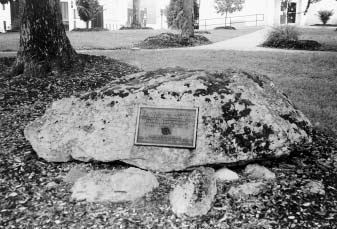
Lieutenant Colonel Tarleton was served his meals—and possibly his tea—on a large, relatively flat, boulder at the campsite. This rock, known as “Tarleton’s Tea Table,” now sits on the grounds of the Lincoln County Courthouse in Lincolnton. It’s on the north side of the courthouse grounds at the edge of the lawn, and it is marked with a D.A.R. plaque. It’s as good a place to have your tea as it was in 1781, and nowadays you won’t have to make room at the rock for a tea enthusiast called Bloody Ban.
General Cornwallis, also a cultured Englishman, looked for natural tea tables too—he preferred not to neglect this afternoon tradition. After Cornwallis’ army decamped from Lincolnton, it marched eastward through Lincoln County towards the Catawba River and Cowan’s Ford (now the site of a huge hydroelectric dam near N.C. Highway 73). The British army crossed Cowan’s Ford on February 1, 1781, under heavy fire from the American army in a rearguard action.
British losses were high—thirty-one killed and thirty-five wounded. General Cornwallis’ horse was shot out from under him during the crossing. The Americans gained valuable time by impeding Cornwallis’ crossing. But the day before the crossing at Cowan’s Ford, Lord Cornwallis stopped at another large, flat rock in Lincoln County for his afternoon tea.
This rock, known of course as “Cornwallis’ Tea Table,” is located about a half mile north of N.C. Highway 73, several miles west of the intersection of Highways 73
and 16. It endures unmarked and covered with lichens, and has probably not hosted a tea in many a year. ffd8ffe000104a464946000