The Silver Cup
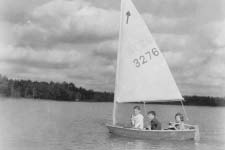
My sister won every sailing regatta she ever entered. A regular corsair of the seas, she was, mateys. Her specialty was skippering a one-sail, dinghy like boat called an El Toro, around several buoys bobbing in the drink. To be truthful, the El Toro is a runty little boat—about eight feet long, with a squared off bow, and a shovel symbol on its sail.
The shovel has something to do with the El Toro classification—the bull. If you are smirking to yourself about this connection, well … you are probably right. Why else a shovel? But I digress.
My sister and her El Toro sailed best in very light winds. The kind of weather when the boats just seem to sit there and the sails wrinkle and luff. Watching sailboat races from the shore is a tedious business at best, but watching a becalmed sailboat contest is a torturous affair. In any event, my sister had the foresight to retire early from the regatta scene and to save her streak from the disappointment that racing as an adult would surely have entailed.
And retiring at the ripe old age of twelve ensured the unique status of her grand silver cup—the first place prize in the Governor’s Cup Regatta of 1964. In recent years, my mother has explained to me that she wanted her three kids to at least taste all the different treats on life’s buffet line. So that is why, in the summer of 1962, she signed us all up for sailing lessons at some marina near the freeway in Berkeley, California, where we were staying for the summer . My mother says she had to wait to sign us up until we were all old enough for the lessons.
In the summer of 62, my sister was ten and a half, my brother eight and a half, and I was seven. I remember two things about these sailing lessons. Just a foot or two below the surface of the water of the lake we sailed in were masses of horrible looking seaweed—probably, in my seven year old mind at least, the nasty home of eels and jellyfish and worse. The sight of these lurking weeds terrified me.
The sailboats were always heeling over in the wind, with the waves lapping only inches from the gunwales. At all times I expected that the little sailboat would capsize and spill us into that water, into the weeds—to struggle to keep our feet from being swallowed by the morass, and probably to be pulled slowly under. I did not want to be out on that water in a
boat that leaned over when the wind blew. I did not want to learn how to sail. I wanted to be safe on the shore. Or better yet climbing on Indian Rock in the Berkeley Hills near where we lived.
And the other thing I remember is that all the boats in this sailing school were El Toros. After that nautical summer of 62, our family moved to North Carolina, and bought a house on a lake in Chapel Hill. Naturally, we needed a boat. And I guess, naturally enough, my parents’ thoughts turned toward those stubby little California boats.
They bought first one wooden El Toro, and soon after a flashy red fiberglass El Toro. The first one was christened “Wee Three,” and the second “Hurry Up Yawl.” Quite witty if you are into sailing—which, alone in the family, I wasn’t. In the winters of 1962-63 and 1963-64, I was into Duke basketball. Duke was quite good in those days.
Those were the days of Jeff Mullins, Steve Vacendak. Jack Marin. Hack Tison. “UCLA, who are they?” we all yelled at Cameron Indoor. I did not care to go to Kerr Lake and Henderson Point to sail those stumpy boats.
I didn’t like water that wasn’t in a swimming pool. Weeds, stumps, frogs— who knew what was down there. But we’d go, they’d sail and I’d wait on the shore, imagining my drives to the hoop and pitching rocks into the deep. And then, one day, the adults got an idea.
There were two other El Toro’s in Durham, owned by two Duke professors (my father was also a Duke prof) as best I can recall. The El Toro sailors were regularly blown out of the waters of Kerr Lake by the classy, speedy Flying Scots, Lightnings, and the other larger boats with jibs and big sails. Those serious sailors were all training for the Governor’s Cup Regatta held every year in North Carolina since 1957. One of the profs checked the rules and learned that if one could assemble three boats in a given class—three El Toros, for instance—the Governor’s Cup Regatta would include a race for that class.
And award a silver cup to the winner. Even if the three boats were stumpy little dinghy boats. Application was made and the entrants signed up. And it was made official.
The 1964 Governor’s Cup Regatta would include an El Toro competition. Recently I’ve asked both my parents and my sister why my sister was chosen as the skipper of our family’s entry in this race. My father simply said that he wasn’t a sailor so it had to be Marjorie. As for Marjorie, it seems the issue had never occurred to her.
She was the eldest and probably more of a sailor than anyone else in the family. And she was probably viewed by my father—and the other two Duke professors—as simply filling out the field so that the two adult sailors could fight it out for the cup. Interestingly from my sister’s point of view, although my father swears there were only the three El Toros in the race, my sister recalls that there were five to seven boats competing. I recall little about the race although I was certainly there— probably flipping rocks into the water.
From my vantage point on the shore, I would have seen a bunch of sails, moving slowly, very slowly, in the distance. The lake water lapping on the red clay shore. My mother says she rubbed furniture wax on the hull of Marjorie’s El Toro before the race. My sister remembered it as some sort of oil.
But everyone agrees that by the time the El Toro division began its race, the wind had died down to a whisper. The boats barely moved. The sun bore down and the skippers pushed their tillers back and forth to try to generate some forward movement. The Toros floated toward the first buoy and very slowly the boat with the lightest skipper pulled in front.
And that was the story of this race. The twelve year old girl was faster because she was lighter, and the Duke professors could only sit, mature and sweaty in their boats, hope for some swaying in the tall pines on the far shore of the lake (indicating the approach of some longed-for breeze), and watch as my sister proceeded them around the buoys and across the finish line. I think I remember Marjorie walking up to the table to accept her award for finishing first—but our family has several black and white photographs of the event and I may just be remembering these photos. But the silver cup she won … well, that cup is etched in my mind, even though I’m sure I haven’t seen the cup in over twenty years.
Six inches high, the cup is engraved with the words: “Governor’s Cup Regatta 1964 1st Place.” No one in the family had ever won such a prize. It was hugely admired. The cup was a family conversation piece and icon for years—heck, it still is even if we haven’t seen it in awhile. For years it stayed on the shelf above the fireplace in our home.
But Marjorie never competed in another regatta. Indeed the 64 Governor’s Cup was her one and only regatta. Our
two El Toros endured sporadic sailing, and lots of rowing and paddling, over the years until they finally fell into disuse, disrepair and final resting places on the shore. The cup eventually went with Marjorie when she left home for good after college. Maybe Marjorie used to handle the cup from time to time and remember the light breeze on her cheek as she bobbed away from the other boats. But maybe not.
She and her husband drank champagne from the silver cup at her wedding in 1979. But then the cup must have gradually receded from her family’s consciousness. There were jobs, kids, there was life. Marjorie says she’s not sure where the cup is now.
Packed away … somewhere. I’ve asked her to find it. And me? Even though I loved the cup, I continued to detest sailing—for many years.
I stuck with the basketball though. I would play for hours on my backyard dirt court every day that I could. I’d play throughout the winter and my hands would become raw and cracked. Vacendak and Marin graduated and Duke hoops started slipping.
But I stuck with it despite Duke’s slide (Bob Verga became my man). And then, in the seventh grade—pay dirt. I was the tallest in my class, and my inside game was dominant. I was the star on the school team.
In one game, we won 22-2, and I scored 12 of our points. Life was good. And then I stopped growing. By ninth grade I was a small forward, and by high school I was an average sized guard with my inside skills intact but no outside shot.
None at all. This part of the story really goes no further—some enjoyable intramural play, I guess, but no more basketball glory. But there was still glory to be found—in particular, a glorious early fall day in the late 1980s. On a whim, I accepted an invitation from some non-sailing friends from school to drive up to the dreaded Henderson Point on Kerr Lake—to go sailing.
We rented a Sunfish. I told them I knew how to sail and I’d show them how. And sure enough, somehow I did know how to sail—knew exactly how to do it. It was a warm day and there was a steady, stiff breeze.
I wheeled that boardboat all over the lake—to the far shore and back, tacking up the lake and blasting back down before the wind. I sailed like a master without even knowing that I knew how to do it. The passengers lying on the deck applauded my skill as they were soaked by the spray. It all just fell into place, on that golden, blustery afternoon.
The boat and I were one with the wind and the water. I was a sailor after all. So when my sister tells me she has found it, I’ll buy the champagne and meet her by the shore. My sister and I will take turns hoisting the icon and toasting.
First to the breeze. Then to the waves. Then maybe the buoys, and even the El Toros themselves. Maybe a small one for Bob Verga.
And we’ll both drink deep from the silver cup.