Encounters with the Shad Fish and the Shad Bones
It’s mid-March. The daffodils and the pear trees are abloom. The average daily temperatures are slowly rising. And the shad are running once again.
After several years in the ocean, ranging as far north as Canada, the shad are entering the mouths of the Roanoke, the Chowan, the Cape Fear and the Neuse Rivers, and they are finning their way as far upriver as their bodies’ stored energy can take them— assuming they aren’t first stopped by dams, pollution or the determined shad fishermen who line the rivers in the early spring. I know that today the shad are running in part because they always do in mid-March in North Carolina. I also know because I’ve seen the reports in the newspaper and on the internet of the increasing number of shad in the rivers.
But the number one reason I know the shad are running is because I caught one today. The chase wasn’t too difficult and I didn’t get my feet wet. And I didn’t use a shad dart. And it only cost me $1.99 a pound.
Yes, I caught my shad in a local specialty grocery store, in the iced display case, surrounded by blue fish, salmon, rainbow trout and king mackerel filets. The trout was $8.99 a pound. But I was after shad—and I was undeterred by the little cardboard sign perched atop the three shad filets that stated: “Has lots of bones.” Yeah, yeah, I knew that. I’d read the book on this famous American fish.
Bones, schmones. And I had the recipe that was supposed to dissolve those ubiquitous shad bones. The shad is a silvery fish built for speed. The mature females usually weigh 5-6 pounds and the mature males 2-3 pounds.
Shad are found as far south as Florida and as far north as Labrador. Although originally an east coast fish, in 1871 some baby shad were introduced to the west and they flourished there. Like salmon, shad are born as far up freshwater rivers and streams as their parents can get before they spawn. The baby shad then float with the river waters down to the ocean and it is in the ocean where shad spend most of their adult life.
The shad swim in schools, covering maybe two thousand miles or more in a year. It is believed that up to eighty percent of all adult East Coast shad spend a part of the summer in Canada’s Bay of Fundy. But by summer’s end they head back out to the open ocean and swim south. In early spring the shad return to the same rivers in which they
were born and, leaving the salty ocean, they start upriver. They’ll swim up their chosen river as far as they can—in some cases up to four hundred miles—until they are stopped by dams or until the water temperature reaches a certain point. Then they’ll spawn, beginning the whole process again. Fishermen who like a challenge like to fish for shad.
Shad are fighters, with a lot of power and a lot of spunk. They jump out of the water a lot when on the line. I’m not a fisherman and I don’t know fish, but it intrigues me that shad do not eat at all after they begin their spawning run and head upriver. During this time they can lose forty percent of their body weight.
But it’s during these spawning runs that fishermen catch the shad using their special shad “darts.” The shad will strike these lures even though they are not eating anything. And, apparently, the shad never swallow the lures, they just hold them in their mouths. This combination makes the shad an exciting quarry for the scads of shad anglers who line the banks and shallows of some rivers when the shad begin their springtime runs. Although the shad still run up east coast rivers in the twenty-first century, their numbers are greatly diminished from colonial times.
The huge runs of shad in the 1700s and early 1800s were of immense importance to those living on the rivers. Celebrated author John McPhee published a book about the shad, calling it The Founding Fish. This was an important fish in American history. Thoreau empathized with the shad (“Poor shad!
Where is thy redress?”). George Washington bragged about catching three hundred shad in his seine at Mount Vernon. Thomas Jefferson claimed there was no greater delicacy than the shad. And there is a much repeated, though probably apocryphal, story of how an early shad run on the Schuylkill River in February or March of 1778 saved the Continental Army camped at Valley Forge from starvation.
Americans and America relied on these huge schools of shad surging up its rivers every spring. It was no different in North Carolina. The WPA Guide to the Old North State tells us that even as far inland as the site of Trading Ford (near present-day Salisbury): “In Colonial times settlers annually met the Indians to trade, especially for shad, near here on the Yadkin River.” And when, as a young man, Daniel Boone lived in the Forks of the Yadkin, he would catch shad with a seine “at the Shoals just above Dutchman’s Creek.” Toward the end of his long journey in the Carolinas in 1701, John Lawson described the following encounter: “We were forced to march, this day, for Want of Provisions.
About 10 a Clock, we met an Indian that had got a parcel of Shad-Fish ready Barbaku’d. We bought 24 of them, for a dress’d Doe-Skin and so went on, through many Swamps, finding, this day, the long ragged Moss on the Trees, which we had not seen for above 600 Miles.” Later in his account, Lawson noted that “[s]hads are a sweet Fish, but very bony; they are very plentiful at some Seasons.” The Native Americans had been experts in catching shad long before the colonists arrived. In his book The American Indian in North Carolina, Douglas Rights, stated: “The Indian was an expert fisherman. He constructed weirs for copious catches.
In the rivers two rows of stone were placed to form a V-shaped figure with the point of the V downstream where the weir or trap was placed. One double fall, shaped like a W, is in the Yadkin River south of Salisbury. Th fishermen beat the water above the fish-fall and drove the fish into the traps. In the spring great catches of shad were made in the rivers.
Many of these stone fish-falls may still be traced in the streams, since the later residents in this region have kept them in repair.” The shad is, thus, an historic fish in these parts. Why not experience this sweet, tasty, bony fish just like so many did centuries ago? So back at home I unwrap my three shad filets and look at them. Little bones are sticking out everywhere.
I plan on slowly baking this fish following one of the recipes in McPhee’s book. On a whim I pull out my old copy of the Joy of Cooking cookbook and look up shad. It’s there, and it says: “Whole fish are often slow-cooked in an attempt (usually futile) to dissolve bones.” Well, okay. I guess we will see who is right about this bone dissolving business.
The shad go in the oven, covered with foil, and I vow to not even open the oven door for several hours so those bones will have little choice but to dissolve away. Hours later I serve dinner. So was the shad tasty? Indeed it was.
It was sweet and I can understand how Thomas Jefferson could have rhapsodized over its flavor. While eating my shad, did I share a sense of identity with all those Native Americans, colonists and citizens of the United States who caught and consumed all those shad
fish in the eighteenth and nineteenth centuries? I most certainly did. Only if I’d caught the shad in my own seine would the experience have been more equivalent. Did the bones dissolve?
Not a one. That is the boniest fish I’ve ever eaten. It is more work creating a forkful of deboned shad than it is getting a forkful of crabmeat from a boiled blue crab. But ultimately all the shad (and a few shad bones … a few hundred or so) were consumed—though it took several days.
And I’m sure the occasional pain I get in my stomach is another of those undigested shad bones making its slow way south. Lawson had warned me—though sweet, shad are simply a very bony fish. There remained, however, one item left to do to complete my shad experience. So a couple of weeks later I journeyed eastward to Grifton, North Carolina, where on the banks of the shad filled Contentnea Creek, the Annual Grifton Shad Festival was in full swing.
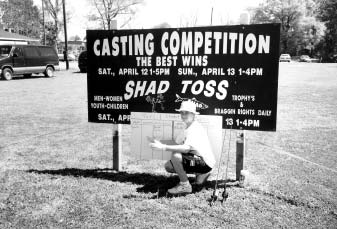
The Festival has the usual crafts fair, rides, cloggers, etc., but it also features free fried shad, a shad fishing competition, a fly rod casting competition, and my personal favorite, the shad toss. As I wandered through the Festival, over to the shad toss, I munched on some of the free fried shad I had waited in line for. Pretty tasty, I had to admit, but still no obvious bone dissolving. The free fried shad was going fast but there weren’t many in line for second helpings.
At the shad toss, from out of a cooler full of ice and shad I picked up and held my first intact shad fish. It was sleek, silvery and a pretty good looking fish. Smooth and somewhat bullet-shaped, it looked like it would have been a fast swimmer. It looked bony too.
I hefted it a couple of times then walked over to the shad toss official. He motioned me forward and I adjusted my grasp around the shad’s slimy midsection. Three steps forward and I flung that fish toward eternity. High up against the blue eastern Carolina sky, flashing in the sunlight, the shad’s tail flipped back and forth as though it were swimming hard through the air.
Its downward arc brought it bouncing and skimming off the grass to where it finally lay still on the turf. They marked my throw and handed me back my shad. As I walked back to the cooler another silvery shad flew high through the air, mouth open and tail flipping. I turned away from the ice cooler with my shad still in hand.
I walked back to the shad toss official. I’d have to throw again.