Peter Ney
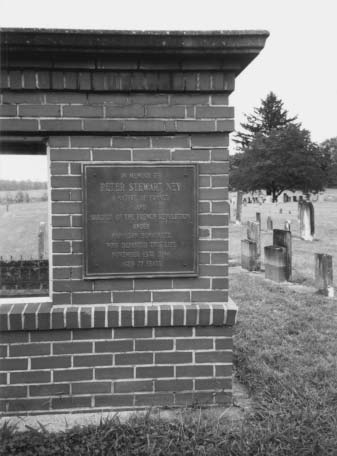
In the fall of 1819, a veteran soldier of Napoleon’s army, who had left France for a life in America, was watching a parade in Georgetown, South Carolina. As a group of horsemen pranced by, the soldier recognized one of Napoleon’s highest ranking officers— a man Napoleon had once described as “the bravest of the brave.” It was Marshal Michel Ney, known to his men as “Red Peter,” because of his reddish-blonde hair and florid complexion. Marshal Ney had commanded the Third Corps of Napoleon’s Grande Armèe, and had fought in the Swiss Campaign, the Russian Campaign and the Battle of Waterloo. Ney had been instrumental in Napoleon’s brief return to power in 1815 after exile to Elba.
So it was somewhat surprising to see Marshal Ney in South Carolina. But what made it particularly strange was that Marshal Ney had been dead for four years. He had been executed by a firing squad in Paris on December 7, 1815. Marshal Ney had been executed for treason because of his help in returning Napoleon to power.
Reports at the time stated that the firing squad consisted of twelve riflemen, that Marshal Ney saluted them and gave the order to fire himself, that the body lay on the ground for fifteen minutes as the law required, and that the body was then taken away and buried in the Père la Chaise Cemetery in Paris. Sounds pretty straightforward—but it was also reported that the twelve riflemen of the firing squad were all veterans who had served under Marshal Ney during the Napoleonic Wars and that the time and place of the execution were changed at the last minute so that the large crowd that had assembled to witness the event were at the wrong location.
At the actual execution site in Luxembourg Gardens, there were few spectators and those present were not even aware of who the person being executed was. A few days later a body said to be Ney’s was buried at Père la Chaise but it is interesting that Ney’s widow did not attend the burial and the family never placed any memorial on this grave. Was Ney’s execution faked? Possibly.
Like many of the high-ranking officers in the armies of the various European countries, Ney was a member of the ancient fraternity of Masons. The Duke of Wellington was a Mason. Masons often protected and aided each other even when they fought on different sides of a war. And both Napoleon and Ney retained broad support among their former soldiers and the general French populace, even after Waterloo and the restoration of the monarchy.
It is also interesting that when Ney was sentenced to death by France’s Chamber of Peers, one of the sentencing options considered was exile to America—and it is reported that of those who voted for death some nevertheless were not comfortable with the death sentence and considered exile to be acceptable. It is possible, then, that after a faked execution Marshal Ney was spirited away to Bordeaux where he boarded a ship headed for Charleston, South Carolina, and relative obscurity. There might not be much more to this story except for a memorial found in the cemetery of Third Creek Presbyterian Church, a church built in 1835, near the town of Cleveland in Rowan County.
The headstone on this grave is inscribed: “In Memory of Peter Stewart Ney a native of France and soldier of the French Revolution under Napoleon Bonaparte who departed this life Nov. 15, 1846, aged 77 years.” Many who knew Peter Stewart Ney believed him to be Marshal Ney. Peter Stewart Ney impressed most everybody who met him. He was routinely described as the “greatest man” they knew. From 1820 until his death in 1846, Ney taught school in various small communities in the Piedmont areas of North and South Carolina, and Virginia.
But he was much more than a schoolteacher. He was a scholar, speaking several languages fluently (including French). He was particularly adept at mathematics. At the request of the Board of Trustees, Ney designed the official seal (still in use today) of Davidson College.
He wrote poetry and contributed to several local newspapers. He was also acknowledged as a master swordsman and horseman. Even in his 60s and 70s he was described as agile and athletic, and always comporting himself with a distinctive military bearing. And Ney had significant scars of combat all over his body—including a deep sabre scar on the left side of his head, sword wounds on an arm and a thigh, and a musket ball in his calf.
The physical similarities between Peter Stewart Ney and Marshal Ney (had he lived into his 50s, 60s and 70s) were great.
They would have been about the same age, same size, coloring and build. Marshal Ney was an expert fencer and cavalryman. And several former soldiers who had known Marshal Ney in Europe upon seeing Peter Ney in America proclaimed him to be the marshal. Perhaps more convincing, and certainly more moving, are the reports of conversations and experiences Peter Ney had with various acquaintances in and around Rowan County, North Carolina.
Although usually reticent to discuss his past (he often said only that he was a French refugee and had fled France for political reasons), to some he revealed details of Napoleon’s campaigns and commented on many of the famous personalities involved in the Napoleonic Wars. Peter Ney also wrote comments in the margins of books about Napoleonic history, noting inaccuracies and making corrections. Ney was absolutely devoted to Napoleon and was devastated upon learning of Napoleon’s death in 1821 and again upon Napoleon’s son’s death in 1832. Peter Ney had confided to some that he expected to return to France when the French people returned a Napoleon to rule over France once more.
The deaths convinced Ney he would never be allowed to return to France—where Marshal Ney’s widow and children still lived. As he lay dying in November of 1846, Peter Stewart Ney was asked to say “who you are before you die.” He reportedly answered “I am Marshal Ney of France.” He died several hours later. Ney’s very last words, uttered while not fully conscious, were: “Bessieres is dead and the Old Guard is defeated. Now let me die.” Marshal Bessieres, the beloved commander of the Old Guard, died in battle next to Marshal Ney in 1813, and despite many victories under Bessieres and Ney, the Old Guard had been defeated at Waterloo.
Much research has been done to investigate the connection between Marshal Ney and Peter Stewart Ney. Much of it (including handwriting analysis) is supportive of this connection. In 1887 the body of Peter Stewart Ney was exhumed and physicians examined the remains for evidence that they expected to find in the remains of Marshal Ney—but they found nothing conclusive. There may be no more evidence to find.
So the mystery may remain forever unresolved. Maybe it is best left as one acquaintance of Peter Stewart Ney said years after Ney’s death: “Well, if he was not Marshal Ney, he ought to have been.” Directions to Ney’s Grave: The Third Creek Presbyterian Church cemetery is northwest of the town of Cleveland. Follow Third Creek Church Road out of town for just over a mile and a half, and look for a left turn on S.R. 1973. The church is on the right in about a quarter mile.