Judaculla Rock
The intrepid petroglyph hunter, finding himself in Mesa Verde National Park, is inexorably drawn to the trail that is known as the Petroglyph Point Trail. But it’s a long trail, with no signs marking said petroglyphs, no obvious points, and lots of smooth rock faces that would seem a perfect home for those rock carvings known as petroglyphs. But we can discern no man made rock art on the canyon wall beside the trail. And the hunter is hurting.
He’s been nursing a bum knee for several months now. So with his two boys, aged 9 and 11, disappearing down the trail, the hunter shouts that there will be a dollar for the first boy to spy a petroglyph. This reinvigorates their fragile interest in rock art and they press ahead. We hike on another half mile or so, turn a corner and there they are—unmistakable, dramatic and mysterious.
There are carvings of mountain goats, human-like figures, geometric designs and much more. They have persisted on this rocky face for several hundreds of years and maybe much longer. Well worth the dollar, in my opinion. Petroglyphs are inscriptions or carvings on naturally occurring rock faces.
Native Americans have left thousands of these carvings across the United States. Some may be a thousand years old while others may be only a few hundred years old or less. Rock art also includes pictographs—which are paintings on naturally occurring rock. Many pictographs survive in the arid Southwest but the rock paintings are much more fragile than the rock carvings.
The meaning and purpose of this rock art is much debated by anthropologist and amateur rock art hunter alike. Petroglyphs sometimes clearly portray animals or hunting scenes, but many carvings are of hand prints, foot prints, and bizarre human like figures that are not easily interpreted. And many petroglyphs are of a great variety of geometric symbols or figures. Are petroglyphs writing or record keeping?
Do they have a religious or ceremonial connection—are they a shamanistic vision? Or are they simply art? Or maybe rock art is all this and more. We may never know.
The petroglyphs that most of us have seen are those found in the American Southwest. Relatively few have been found in the eastern states. But petroglyphs do exist throughout the United States. There may be more rock art in the Southwest than in the East but it is also true that there is simply less exposed rock in the East.
Particularly in the Southern states, the vegetation and high humidity may hide and disguise the rock art that does exist, and both probably contribute to the natural deterioration of both pictograph and petroglyph. Additionally, the greater population concentrated in the East and the resulting construction and development has probably destroyed the natural habitat of eastern rock art or at least limited the petroglyph hunter’s access to or knowledge of the site. It does seem likely, however, that there are numerous lichen-covered petroglyphs in the eastern states that are waiting to be rediscovered.
South Carolina may prove this point. In the late 1990s, South Carolina’s Institute of Archaeology and Anthropology initiated a “Rock Art Survey.” This survey used volunteers to walk over certain tracts of land looking for petroglyphs and it also used media outlets to ask the general public to report any possible rock art sites. In its early stages this survey resulted in the recording of approximately 150 rock art sites in South Carolina. Although the professional anthropologists may know differently, there are few publicly acknowledged petroglyphs to be found in North Carolina.
But there is one very famous one. It’s located in Jackson County near Cullowhee and it’s known as Judaculla Rock. To visit this rock, get yourself to Cullowhee (where a Native American effigy mound located on the campus of Western Carolina was excavated in 1898 and leveled by campus construction in 1956) and then travel south on N.C. 107 for about three miles. Turn left (east) on Caney Fork Road (S.R. 1737)—at this intersection you’ll also see a silver state historical marker for Judaculla Rock.
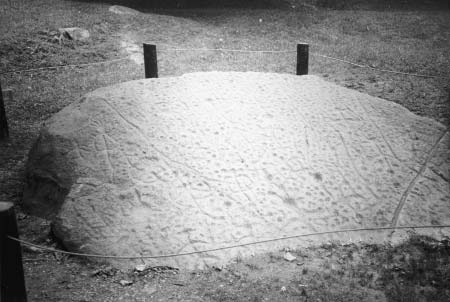
Follow this road, paralleling Caney Fork Creek, for about two and a half miles and you’ll see a sign for Judaculla Rock on the left—turn left on this gravel road. The road winds through a field gradually turning to the right—after about a half mile you will look to your right down a short slope and see the rock and viewing platform. Park and walk down to the rock. Judaculla is a big rock and it is absolutely covered with rock carvings.
Many of the carvings are cuplike depressions in the rock,
known as cupules—possibly used for ritual purposes. There are also many deep grooves in the rock. And then there are the designs and figures, some of which look like footprints, humans, humanoids, birds and some that just look fascinating and mysterious. Some researchers claim to have discerned on Judaculla Rock the famous Kokopelli figure depicted in many petroglyphs found in the desert Southwest.
The Kokopelli figure is said to be a hunch-backed, dancing flute player, and, indeed, there is a Judaculla carving that could be viewed as such. Researchers in the late 1800s concluded that those who created the petroglyphs on Judaculla Rock were from a culture that pre-dated the Cherokee. James Mooney, one of these researchers, nevertheless gathered this story from the Cherokee: Judaculla (Tsul-ka-lu) was a great slant-eyed giant who lived on the top of a mountain above the Tuckaseegee River. One time Judaculla jumped from his mountain top and landed on the rock, leaving the imprints that we see today.
One of the petroglyphs on the rock does somewhat resemble a seven-toed foot and the giant may have had seven toes. The sheer number of petroglyphs on Judaculla Rock are impressive but the detail and intricacies of these figures can be difficult to appreciate when viewing the rock in person. This is because (unlike the contrasting colors on the “desert varnish” rocks in the Southwest) the carved and uncarved portions of Judaculla Rock are of a uniform color and do not provide the contrast that would be helpful in making out all the shapes. Excellent artists’ reproductions of all the figures on Judaculla Rock are available in books and on related sites on the internet.
These reproductions are well worth viewing before and after your visit to Judaculla Rock.