The Forks of the Yadkin
It’s Dan’l Boone and Kentucky, right? Boone—that Indian-fighting frontiersman, who cut out the Wilderness Road through the Cumberland Gap, and who led parties of settlers along this path to populate the great blue grass state. Boone founded the fortress town of Boonesborough on the Kentucky River and defended it against Indian attack throughout the 1770s and 80s. Boone carved his name on trees (note: a famous carving discovered on a beech tree on the banks of the Watauga River read: “D.
Boon CillED A. Bar on tree in the YEAR 1760”) and was a legendary bear hunter. Once he was captured by the Shawnee, taken far north to their Ohio town of Chillicothe. Boone lived with the Shawnee for a year and was adopted as a son by the local chief.
He later escaped and traveled hundreds of miles by foot to Boonesborough to warn of a planned Shawnee attack. Boone later served as a legislator and was the subject of a popular book about frontier life in America—John Filson’s The Adventures of Col. Daniel Boone published in 1784. In all his ramblings through trackless miles of wilderness, Boone claimed he’d never been lost a day in his life—though he allowed as how once he had been a tad “bewildered for three days.” And, of course, as many of us recall, Dan’l Boone had his own television show in the 1960s.
But this famous man will forever be associated with Kentucky and its settlement by those of European descent in the years before and during the Revolutionary War. It may not generally be known, however, that from age sixteen until his early forties, Daniel Boone was a North Carolinian. Boone was born in Pennsylvania in the fall of 1734, the sixth of eleven children. In 1750, Daniel’s parents, Squire and Sarah Boone, moved the family down the Great Wagon Road to the North Carolina Piedmont, to an area where two prongs of the Yadkin River come together—an area known as the Forks of the Yadkin.
Local tradition tells us that at first the Boones stayed in or near a cave on the eastern bank of the Yadkin in Davidson County. Boone’s Cave, once a state park and now leased to the county for use as a park, is found fourteen miles west of Lexington, off of Highway 150. Look for signs for Boone’s Cave Road. A few miles downstream from Boone’s Cave is where the South Fork of the Yadkin splits off toward the west and the Brushy Mountains.
The other branch of the Yadkin heads north (upstream) past Winston-Salem until it turns west and forms the boundary between Surry and Yadkin Counties. This branch of the Yadkin flows through Elkin and Wilkesboro. The Yadkin’s source is found in Blowing Rock. Daniel Boone would come to know these rivers, and the land in between them, very well.
Squire Boone purchased hundreds of acres in the Forks of the Yadkin, near the present-day town of Mocksville in Davie County. West of Mocksville U.S. 64 crosses over Bear Creek. A state historical marker just before the bridge proclaims: “Boone Tract: In 1753 Lord Granville granted 640 acres on Bear Creek to Squire Boone who sold it in 1759 to his son Daniel. This was part of the original Boone tract.” During this time, the elder Boone children were marrying and starting their own families.
It is said that although Daniel’s help, as the oldest child remaining at home, was needed on his father’s farm to clear and plow land, and to tend the crops and livestock, Daniel “never took any delight in farming.” Daniel much preferred the life of a hunter. An excellent shot, Daniel would disappear into the woods for days, shooting deer and bear, and then pack his deerskins for trade in the tiny commercial hub of the region—the crossroads town of Salisbury in Rowan County. But Daniel stuck around home long enough to court one of the daughters of a nearby family. Daniel Boone, age twenty-one, and Rebecca Bryan, age seventeen, were married on August 14, 1756.
They moved into a cabin on Sugartree Creek about two miles east of present day Farmington in Davie County. And by the time Rebecca turned twenty, she and Daniel had four children. More would follow. Daniel and Rebecca lived at the cabin on Sugartree Creek for about ten years.
Daniel continued his wandering ways, going on hunting trips for weeks and months at a time. In 1760 he crossed the Blue Ridge for the first time, in 1761 he fought with General Rutherford in the campaign against the Cherokee, and in 1765 he explored Florida. His wandering may have been encouraged by financial problems and the death of his father. Court records in Rowan County show a judgment against Daniel Boone in 1764 for the substantial sum of fifty pounds.
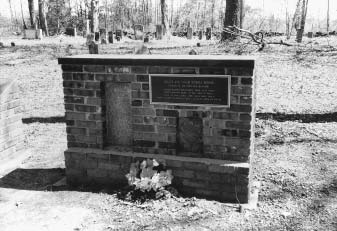
Daniel’s father, Squire Boone, died in 1765. Squire and Sarah Boone are buried
in the Joppa Cemetery northwest of Mocksville on U.S. 601 (park in the shopping center parking lot next to the cemetery). Whatever the reason, in 1766 Daniel and Rebecca moved their family many miles up the North Yadkin River to Holman’s Ford near where Highway 421 crosses the Yadkin south of Wilkesboro. Soon afterward they moved again, this time building a cabin further upriver on the north side of the Yadkin on a hill overlooking the river and opposite the mouth of Beaver Creek, near the present-day town of Ferguson, in Wilkes County. The remains of this cabin were visible well into the twentieth century.
Rebecca raised the children and ran the home place while Daniel explored. He reached Kentucky for the first time in 1767 and for a second time in 1769. It was on this latter trip that Boone was captured by the Shawnee and taken to Ohio. It would be two years before he returned to North Carolina, Rebecca and the cabin on the Yadkin.
But Boone persisted in returning to Kentucky, taking settlers and occasionally his family with him. Rebecca left Daniel and Kentucky to return her family to the Forks of the Yadkin on at least one occasion, but finally left North Carolina for good in 1778—to reunite the family in Kentucky. There are many other sites in North Carolina associated with Daniel Boone—various gaps he passed through, springs he used, and, of course, the town of Boone where Boone kept a hunting cabin in the 1760s. There is also much literature trying to retrace the various paths or trails that Daniel Boone followed.
Old U.S. 421 west of Boone (leading north to Zionville and Trade, Tennessee) is said to follow Boone’s Trail and has several historical markers commemorating Boone’s route. One of the most intriguing sites to visit is the cemetery near Obids off Highway 163, fifteen miles or so northwest of Wilkesboro (follow Highway 16). In the Calloway Cemetery is the gravestone for Captain Thomas Calloway. Surmounting this monument is a stone shaft that Daniel Boone used as a campsite marker—and inscribed on this marker are the initials “T.C.” It is said that Boone carved those initials himself and placed this stone on the grave of his friend Thomas Calloway.
Boone lived a long, productive and exciting life as he followed the frontier as it advanced ever westward, always being harried from the rear (or east) by new homesteads and advancing civilization. Boone’s adventures in Kentucky and Ohio are well worth discovering—but we can also walk in the footsteps of the young Daniel Boone in and around the creeks and woods of the Forks of the Yadkin. Postscript: Even Kentucky finally became too settled and crowded for Daniel Boone. Boone continued his life-long westward migration by moving his family to Missouri in 1799—he died there on September 26, 1820.
Although initially buried there his remains (and Rebecca’s) were disinterred and reburied in Frankfort Cemetery, Frankfort, Kentucky in 1845 (although there is some debate as to whether the correct body was exhumed). For further information about D. Boone, his life and times, see: John Mack Faragher, Daniel Boone: The Life and Legend of an American Pioneer (Henry Holt and Co., 1992) George H. Maurice, Daniel Boone in North Carolina (Murray Printing Co., 1955).
This book has maps and photographs of the various Boone home sites in North Carolina.