Barbecue Church, Cross Creek, and Flora Mac
I drive south from Sanford on Highway 87 into Harnett County and exit on Highway 27 which my map says is also called Barbecue Church Road. After a few miles I see the historical marker for the Barbecue Church, “founded in 1757 by Scottish Highlanders.” The present Barbecue Church, built about 1895, stands about 100 yards away on my left. Behind the church building is a cemetery. I walk through the headstones toward the tree line and soon find the oldest section of the cemetery—near where the original church building must have stood.
Sure enough, in the woods at the edge of the cemetery is a large stone “Cairn of Remembrance” marking the site of the original log church, which a plaque indicates was “the first permanent place of worship in Harnett County.” I walk further into the woods and find a leaf covered path leading down a bluff toward the bottom land around a creek. At the end of the path, at the base of the bluff, I find the inverted pipe that now protects the Barbecue Church spring—the spring that quenched the thirst of the Scottish Highlanders that had migrated to the area and founded the church in the mid-1700s—the spring that quenched the thirst of one famous church member in particular—Flora MacDonald, the heroine of Bonnie Prince Charlie’s successful escape from the English dragnet in 1746.
It is said that she was the most famous woman in pre-Revolutionary War North Carolina. I linger at the spring, listening to the rustle of the leaves. After a time, I head back up the path. Next stop is Cross Creek Charles Edward Stuart, aka Bonnie Prince Charlie, grew up Catholic in Rome, Italy, but believed he was rightfully destined to be the king of England.
With encouragement from France, Bonnie Prince Charlie, at the age of 25, landed in Scotland and gathered his Scottish supporters for an attack on the English. On 16 April 1746, at the Battle of Culloden on Drummossie Moor, the English forces, led by King George’s son, William, the Duke of Cumberland, decisively defeated Prince Charlie’s army of Scottish Highlanders. The bonnie prince escaped from the field of battle and headed north into the Highlands. The Duke of Cumberland gave chase and devoted his large naval and land forces to the capture of the prince.
Cumberland also engaged in brutal reprisals on the Scottish people, earning the nickname the “Butcher.” A reward was placed on the prince’s head and those suspected of aiding the prince’s escape were jailed and had their property confiscated. Nevertheless, Bonnie Prince Charlie eluded capture for five months and somehow was able on 20 September 1746 to board a French ship sent to save him and to sail through the English blockade to safety on the continent. Prince Charlie’s five month flight to escape the English manhunt is a tale full of close calls, bravery and luck. Despite the punishments meted out by Cumberland’s men to those who aided the prince, Scottish Highlanders continued to help the prince as he hid in sheds and caves, trekked across mountain and valley, and traveled in small boats to various islands thought to be safe.
One famous chapter in the escape involved a comely 24 year old Scottish lass who risked her family’s and her own health and wealth by smuggling the prince to the Isle of Skye. Flora MacDonald, two years younger than the bonnie prince himself, was asked to help with his escape and by all accounts she never hesitated to agree. The prince disguised himself in women’s clothes and became “Betty Burke,” a servant of Flora. Their small band passed through several checkpoints in this disguise, succeeding largely through Flora’s calm, charm and believability.
Betty Burke’s appearance and awkward gait were explained by noting that she was an Irish girl. Flora accompanied the prince on the long boat ride to the Isle of Skye during which they were fired upon and endured a sudden squall that came near to swamping their small skiff. But the escape was successful and after eleven days together, Bonnie Prince Charlie parted from Flora on 1 July 1746 to continue his flight. It is said that at their parting, the prince kissed Flora’s hand and told her: “For all that has happened I hope, Madam, we shall meet in St.
James’ yet.” But Prince Charlie never made it to London, and also never communicated with Flora again. Denied another chance to recover his crown, Prince Charlie died in exile in 1788, reportedly a bitter, cantankerous alcoholic. But in July 1746, Flora MacDonald’s troubles had just started. English authorities discovered her role in aiding Prince Charlie’s escape and she was arrested.
In November of 1746 she was taken to
London and imprisoned in the Tower of London pending her trial. She remained in custody for 12 months. But, as sometimes happens, Flora MacDonald’s story, her obvious courage, capabilities and beauty, captured the imaginations of the public and the aristocracy. Her case never went to trial, and instead she was released and, for a time, became “an idol of London society.” Flora was visited and feted by London’s upper crust.
Many artists asked her to sit for portraits. Dr. Samuel Johnson, upon meeting her, described Flora as follows: “[Her name] will be mentioned in history, and if courage and fidelity be virtues, mentioned with honor. She is a woman of middle stature, soft features, gentle manners, and elegant presence.” Flora was an object of great honor and celebration upon her return to the Scottish Highlands.
In 1750, she married Allan MacDonald, a landed gentleman. The MacDonalds’ life must have been idyllic for a time. But it is believed that financial troubles gradually grew for Flora and Allan MacDonald so that in 1774 they decided it best to immigrate to America with five of their seven children. After the Battle of Culloden many Scottish Highlanders had immigrated to America and many had settled in North Carolina in the area around present day Fayetteville.
That is where the MacDonalds headed. In 1774 the community was called Cross Creek. According to the WPA Guide, in the 1740s, “a group of expatriated Scots, men who had escaped the penalty of death to one of every 20 survivors of Culloden,’ established a gristmill and village at Cross Creek …, where they found two streams crossing each other.” The Guide also states that the two streams “met and apparently separated, forming an island of some size. It was said that the streams, when swollen from the rains, actually crossed each other in their rapid course.” But, alas, this fascinating crossing was eliminated by the construction of a cotton mill on the site by a Frenchman named De Gross in the 1740s.
But the name stuck. Allan and Flora settled in a home on the banks of Cross Creek in 1775. Fayetteville has grown up around and over the old settlement of Cross Creek. The Flora MacDonald house is long gone but the house site is said to lie on the northeast corner of the intersection of Green and Bow Streets—close to the traffic circle at Market Square.
Sure enough, at this intersection the meandering Cross Creek flows under the highway past a small park and a First Union Bank where the house must have once stood. A small map in the WPA Guide shows the old site of the crossing creeks nearby, on the north side of Rowan Street. But the present day land no longer fits this old map. It looks like at some point Cross Creek was diverted into a new stream bed so that it now joins Blounts Creek near the Hawley Lane bridge on the south side of Rowan Street rather than the north side.
And the old stream bed of Cross Creek, which used to form the western border of the Cross Creek Cemetery, and the actual site where Cross and Blounts Creeks may have once actually crossed each other, appears to have been buried deep under many loads of backfill. A city maintenance facility enclosed by a chain link fence now borders the cemetery sitting atop this landfill—high above the old Blounts Creek ravine, which now carries the waters of both Blounts and Cross Creeks. The sites are there but it takes some imagination to see them as Flora MacDonald would have seen them in 1775. The MacDonalds’ time in America was not destined to be easy or lacking in ironic twists.
First of all, the MacDonalds had settled in Cumberland County, formed in 1754 and named after the bloody Duke of Cumberland—the English victor at the Battle of Culloden, the pursuer of Bonnie Prince Charlie and the man whose savage reprisals against the Scottish Highlanders after Culloden was the cause of the large Highlander migration to America in the 1740s and 1750s. It was also true that most of the Highland Scots who left Scotland for America following the Battle of Culloden were forced to solemnly pledge allegiance to the British king, promising that if they broke their pledge they would be “cursed” in all their “undertakings, family and property.” This oath presented a problem in the late 1770s for the Highlanders in North Carolina when their friends and neighbors sought their support for the burgeoning movement for American independence from Britain.
The Highlanders had good reason to detest the British monarchy and to feel great sympathy for the American revolutionaries—but whether because of the oath or because of their long history of being ruled by kings, the Highlanders generally chose to remain loyal to the Crown. Flora and Allan MacDonald were not exceptions.
When the royal governor of North Carolina sought to raise troops to oppose the American revolutionaries, he turned to the Scottish Highlanders in the Cross Creek area. Many of these men were military veterans who had fought at Culloden. They were willing recruits for the loyalist side. One of their leaders was Flora’s husband, Major Allan MacDonald.
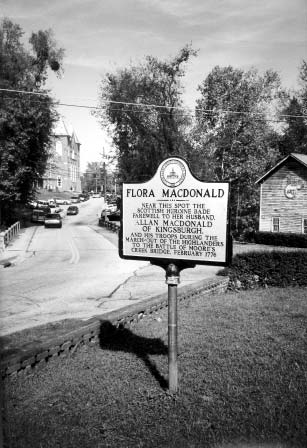
In February of 1776 the Highlander army gathered at Cross Creek and prepared to march toward Wilmington to engage the rebel patriots. There to exhort and inspire the soldiers was the most famous woman in North Carolina—Flora MacDonald. Mounted on her white pony, Flora spoke to the troops in Gaelic, rallying them to the loyalist cause by speaking of Highland heroism, devotion and honor. The troops responded enthusiastically and began their march.
As they passed by her, it is said that Flora MacDonald called out to each clan its Gaelic battle-cry. The site of Flora’s review of the troops as they marched to battle is where Cool Spring Street spans Cross Creek—on the south side of the creek. The spot is marked by an historical marker. The Highlander army, started out with glory, but met a vainglorious end.
Nine days after leaving Cross Creek, on 27 February 1776, in the early morning darkness, the Highlanders sought to cross over Widow Moore’s Creek in Pender County. The Patriots under General James Moore had, however, been expecting them, and had removed planks from the bridge and greased the logs that remained. When the Highlanders surged forward, shouting “King George and broadswords!” the Patriots responded with withering rifle fire. The Patriots were well entrenched on their side of the creek, and their rifles decimated the charging loyalists.
The Highlanders lost about seventy killed or wounded while the Patriots had none killed and only two wounded. Eight hundred and fifty Highlanders were taken prisoner. The Patriots’ victory at the Battle of Moore’s Creek Bridge was decisive, and eliminated the Highlanders as a significant factor in the fighting. The defeat profoundly impacted Flora MacDonald.
Her husband was imprisoned and taken north—not to be released until 1778 as part of a prisoner exchange. Flora remained in North Carolina but was the object of many petty and not-so-petty reprisals by those who resented her role in supporting the loyalist cause. Her estate was confiscated by the Act of November, 1777, passed by the Provincial Congress sitting in New Bern. Her grown daughters were also mistreated by members of the Patriot army.
Flora resolved to leave America and return to Scotland. She journeyed to Wilmington where she was forced to sell what remained of her silver service (some of which had been gifts from wealthy London admirers) to raise cash for her trip home. Some of these pieces are still in the possession of families in the eastern part of North Carolina. Finally, in 1779, after five years in America, Flora, with only one of her daughters, set sail for Scotland—leaving from Charleston, South Carolina.
Her travails were not quite over though. Her ship was attacked by a French vessel, and, it is said, that she stayed on deck during the hand to hand fighting—urging the British seamen on and suffering a broken arm during the melee. Flora returned to the house she and her husband had left in 1774, where her husband, Allan, was not able to rejoin her until 1783. Flora MacDonald died in 1790 and is buried on the Isle of Skye.
It is said that she was buried shrouded by a sheet on which Bonnie Prince Charlie had slept during his flight in the Highlands in 1746. She had kept this sheet, and a lock of the prince’s hair, for forty-four years—she took them with her to America and they were one of the few possessions with which she was able to return to Scotland. A monument to Flora MacDonald on Castle Hill, Inverness, Scotland, has the following inscription: “As long as a flower grows in field the fame of the gentle lady shall endure.” I leave the site of the Highlanders’ “March-Out” on Cool Spring Street, cross over Cross Creek and drive by the Cross Creek Cemetery on my right.
I turn left on Rowan Street and then right on Ramsey Street heading north. I’m still thinking about Flora MacDonald’s difficult five year stay in North Carolina—and just what those early settlers could have seen that made them think that two creeks actually crossed each other. I almost miss my left turn into the Veteran’s Administration Hospital where, underneath a line of trees on the south side of the entranceway, running from the Hospital back to Ramsey Street, is a well preserved segment of a Confederate trench—built to defend the city of Fayetteville from federal attack in 1865. I park and walk along the earthworks.
But my heart is not in this trench. I’m still thinking about the meandering course of Cross
Creek as it must have been in the mid-1700s as it flowed toward its storied meeting with the waters of Blounts Creek. And I’m thinking about the strange turns in the life of Flora Mac and her short stay on the banks of Cross Creek. f