The View from the Firetower on Flat Top Mountain
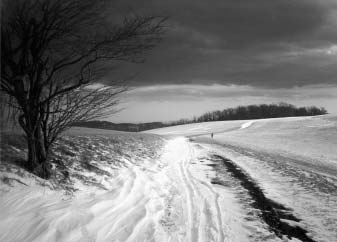
Since the late 1970s, at regular three or four year intervals, I find myself standing at the top of the firetower on Flat Top Mountain taking stock of what I’ve done and what I want to do in this life. Sometimes it’s winter and I’ve cross-country skied to the top. Sometimes it’s summer and I’ve jogged the trail to the tower—and sometimes I’ve just walked it. I always stand at the top, hands on the rail, and slowly scan the 360 degree view, from Grandfather Mountain to the west, and the town of Blowing Rock to the south.
I stay there long enough—I’m usually there all by myself’until I compose, and say out loud, what I call a “Flat Top Firetower Statement.’ The statement is always about what I’ll get done before I next climb the carriage trail up to Flat Top Mountain and stand atop the firetower. And maybe I don’t really say it out loud—but it always feels like I do.
The trail up Flat Top Mountain begins at the parking lot for the grand old mansion that houses the Southern Highlands Handicraft Guild on the Blue Ridge Parkway between mile posts 292 and 295. It’s also just up Highway 221 from Blowing Rock.
Moses Cone, a giant of the textile industry in the late 1800s, built the house which he called “Flat Top Manor.’ Cone and his wife bought up much of the surrounding land and built 25 miles of interconnecting carriage trails that meander over the vast estate, including the one that goes to the summit of Flat Top, at 4,558 feet above sea level.
Cone died in 1908. In 1950, Cone’s widow, Bertha, deeded the estate to the National Park Service’it became Moses H. Cone Memorial Park, 3,517 acres of field, forest and mountain. The carriage trails that run throughout the property were built to have only gentle grades’making for consistently mild to moderate climbs, easy on the hiker or runner, and ideal for the cross-country skier.
Walk down the steps from the Manor House parking lot to the gravel road that leads toward the Carriage House. Turn left on the road and cross under the Blue Ridge Parkway. At the first intersection, bear to the right’this is the Flat Top Carriage Trail (to the left is the Rich Mountain Carriage Trail). You will ascend along the old road with the forest on your right and a pretty field on your
left. A switchback to the right will take you into the forest and after about three quarters of a mile you will enter a large open field. At about the one mile point on your left you will see the Cone family cemetery, where Moses and Bertha Cone are buried. It is a lovely spot and an appropriate place to think of the Cones and to thank them for preserving the land for our use.
The carriage trail continues across the broad field which slowly rises up the flanks of Flat Top toward its forested upper slopes.
You enter the forest at about 1.5 miles and begin a series of twists and switchbacks up through the forest. It can be muddy in places with pools of water if it has rained recently.
But the ascent is gradual and the forest lovely.
The summit and the firetower are reached at about the three mile mark. And after you have climbed the tower, surveyed the high country in all directions and considered and crafted your own statement’if such is your wont’then it is three miles back down to the parking lot.
When I climb up the steps of the firetower and finally stand at the top, I never can recall much of the details of the last Flat Top Firetower Statement.
But even if I didn’t feel so great about life at the trailhead, by the time I’m on top of the firetower I’m usually feeling pretty good. And pretty optimistic. I gaze over at Grandfather Mountain and wait until the latest statement forms in my mind. Then I either say it, or think I say it, take a last 360 view and head down the tower, down the carriage trail, past the Cones” resting place, and back into the life of a flatlander.
Until next time.
For more information on Moses Cone and his time on Flat Top, see Philip T. Noblitt’s A Mansion in the Mountains: The Story of Moses and Bertha Cone and their Blowing Rock Manor (Parkway Publishers, 1996)