Faith Rock
It’s very early April and the bare trees of the hardwood forests on either side of Highway 64 show not the slightest tinge of green. But near the edge of the road’s right of way there is the occasional neon purple glow lighting up the browns and grays of the deeper woods. The redbud is abloom. The Piedmont spring is foretold.
Winter is over. I’ve passed through Siler City and Ramseur. Soon I drive over the Deep River. I’m now in the heart of what once was the country of Colonel David Fanning.
David Fanning—the bald headed, silk skull-capped, Loyalist officer in the King’s militia who shot, hung and murdered many patriots in Randolph and Chatham County in the early 1780s during the Revolutionary War. Fanning was a grim, but memorable, kind of guy. One historian, Samuel A. Ashe, has commented that Fanning “was one of the boldest men, most fertile in expedients, and quick in execution, that ever lived in North Carolina.
Had he been on the Whig [Patriot] side, his fame would have been more enduring than that of any other partisan officer whose memory is now so dear to all patriots.” Even after Cornwallis’ surrender at Yorktown in October of 1781, Fanning continued to lead a deadly backcountry civil war against the patriots until he fled to South Carolina in April of 1782. It should be mentioned that when, after the war, the North Carolina legislature passed the generous Act of Pardon and Oblivion, which granted clemency to most former Loyalists in the state, three individuals were specifically exempted because of the egregious nature of their depredations during the war.
One of them was David Fanning. Fanning’s exploits included an invasion of the town of Pittsboro where he took 53 prisoners which included “virtually every important citizen in Chatham County,” and later in 1781, a raid on Hillsborough where he took 200 prisoners including Governor Thomas Burke. Fanning also led the Tory band which attacked Philip Alston and his family at the House in the Horseshoe in Moore County in August of 1781. Bullet holes from this attack can still be seen in the walls of the house which is now a state historic site.
Another famous Fanning story involves a patriot’s lucky escape from Fanning’s rough justice by use of Fanning’s favorite horse, a great exposed rock jutting into the Deep River and the river itself. It also happened in that busy year of 1781. Across the Deep River and heading west on Highway 64, I turn right onto Faith Rock Road. This road ends at Andrew Hunter Road (State Road 2235).
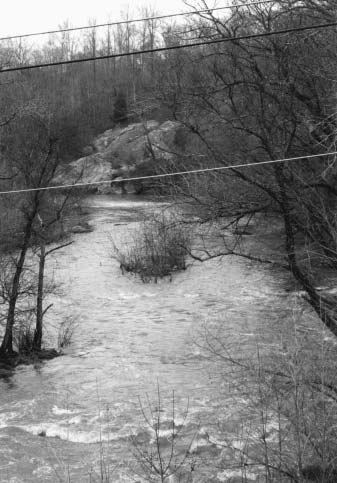
I turn right and ride down the short hill to the Andrew Hunter Bridge over the Deep River. A few hundred yards further along this road I pass an old abandoned factory on the right and just past the factory I see the small parking area (also on the right) and the Andrew Hunter Pedestrian Bridge. I park and walk across the narrow pedestrian bridge glancing upriver—but I see no rock, just a broad, deep river. Once across the bridge there is a sign that says “Faith Rock” and an arrow pointing at a trail that heads off to the right along the river.
I follow the trail. Andrew Hunter was an outspoken Randolph County Patriot. David Fanning had sworn to capture and execute Hunter. One morning Fanning and his men succeeded in capturing Hunter.
They determined they would hang him after they had their lunch. Somehow, during their repast, Hunter was able to free himself and jump upon David Fanning’s favorite horse, called Bay Doe, and to ride off. Fanning, known as a superb horseman who treasured his mounts, is reputed to have ordered his men to give chase and “kill the rascal but spare the mare.” This order may have caused Fanning’s men to hold their fire, or at least hesitate before firing at Hunter, for fear of wounding the horse. So Hunter galloped away toward the Deep River.
He was trying to reach one of the several fords that would let him cross the Deep River and escape. But each ford he came to was guarded by Fanning’s men. Desperate and running out of time, Hunter rode up a bluff overlooking the river. He could see that between him and the river below was an exposed rock face that sloped down to the river at an angle of some sixty degrees or so.
Facing capture if he lingered, Hunter spurred his horse down the steep rock slope and plunged into the murky waters. Bobbing to the surface, Hunter and Bay Doe then floated down river. Fanning’s Tories apparently were so surprised and impressed that they fired no shots at the swimmers. Reportedly one of Fanning’s men exclaimed, “If he has faith enough to try to escape that way we will not shoot again.”
I walk along the river bank until I see the huge exposed rock, steeply sloping up to my left, that would indeed provide a clear path from the high river bank down to the river—if you had the nerve and the skill to urge a horse down its terrifying expanse, hooves skittering on the bare rock, knowing there would be no place to stop short of the cold waters of the Deep River. It must have been a mighty splash. And an impressive feat to watch. Certainly no one was going to give chase, at least not by following the route Hunter had taken.
Col. Fanning must have been furious. He lost his prized horse and pistols and valuable papers that had been in the horse’s saddle bags. Presumably Hunter rode Bay Doe up out of the Deep River some ways downstream and successfully avoided Fanning and his men to return to his home.
And although it isn’t really clear that Andrew Hunter had any other choice, the big rock has been called “Faith Rock” ever since—a monument to troubled times and one man’s remarkable luck and spirit. I hike back along the river and cross the pedestrian bridge. I drive back out to Highway 64 and then head northwest across Randolph and Davidson Counties. I cross the Yadkin at the famous Shallow Ford and follow the ever-expanding improvements to Highway 421 toward my destination for the night, Boone.
Once through Deep Gap, high on the Blue Ridge plateau, I see no more neon glows in the forest’s edge. It is winter once more. For more on David Fanning and related matters, see: David Fanning, The Narrative of Col. David Fanning, published December 1861; Fanning was born in Virginia in 1755; his father drowned in the Deep River before David was born and his mother died when he was nine; Fanning and his sister were raised in Wake County by a guardian; Fanning suffered from an “offensive scalp disease,” called “scald head” or “tetter worm” which left him bald and caused him to usually wear a silk skull cap; Fanning was deported to Canada in 1784 and he died March 14, 1825 in Nova Scotia. Daniel W.
Barefoot, Touring North Carolina’s Revolutionary War Sites, (John F. Blair, Publisher, 1998) for information about North Carolina during the Revolutionary War, David Fanning, Faith Rock and the House in the Horseshoe.