Burnt Churches in South Carolina's Lowcountry
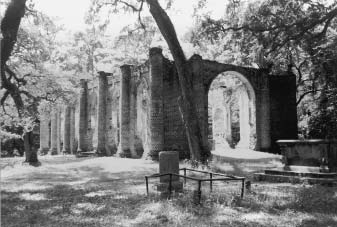
In the early 1700s, the lowcountry of South Carolina was quick to attract European planters, who would become wealthy growing indigo and rice, with the crucial help of the forced labor of a substantial population of African slaves. The second oldest town in South Carolina, Beaufort, was founded in 1711, and in the 1740s the local planters built a church, fifteen miles northwest of Beaufort, that was said to rival the finest churches in Charleston. The Church of Prince William’s Parish had Greek temple columns and three and a half foot thick brick walls. The church must have been an important symbol for the lowcountry aristocrats around Beaufort — and that may have led to its visitation by British General Augustine Prevost during the Revolutionary War.
In 1779, the British Army under General Prevost invaded the area and burned the church — though much of the walls and columns refused to fall. It is said that for a time parishioners continued to worship in the ruins of the church. In the 1820s the church was rebuilt and renamed the Sheldon Church of Prince William’s Parish — named either for the nearby Sheldon Hall Plantation or for Gilbert Sheldon, the seventy-eighth archbishop of Canterbury. Legend tells us that sometime after the church’s second consecration, a Beaufort woman delivered to the church the parish’s original communion silver which had been thought lost in the 1779 fire.
The woman explained that a British soldier had saved them from the fire and given the silver to her for safekeeping. But the church would once again prove an unsafe haven. Sheldon Church was burned once again in 1865 by the Union Army under General Sherman as it marched north toward Columbia and Raleigh intentionally destroying much of what it encountered. And once again much of the church refused to collapse.
Much of the brick walls and columns remained standing, and remain to this day. The ruins of the church are still used every year by descendants of the original parishioners to worship on the second Sunday after Easter. The ruins of Old Sheldon Church are reached by driving north on Highway 21 from Beaufort. Turn left or west on Highway 17, and after about a quarter mile, north on Old Sheldon Church Road.
The ruins are just down this road.
Nearby, east of Beaufort, is St Helena Island, the site of another, much smaller, burnt church. St. Helena Episcopal Chapel of Ease was built in the 1740s for the island’s wealthy planters. The chapel was built of tabby — a type of cement made from oyster shells, lime and sand.
But in 1886 when the fire locals were using to clear land burned out of control, the chapel was destroyed — although much of the external structure remains standing. It is a quiet, peaceful and calming spot. To get there, head east from Beaufort on Highway 21 and turn right or south onto Land’s End Road. Down the road on your left you will see the ruins of the chapel.
A third burnt church is found further inland, about ten miles southeast of Walterboro in Colleton County. It was the first church established in St. Bartholomew’s Parish and the original wooden building, built in 1726, was burned down by Yemassee Indians in the early 1750s. A brick chapel, Pon Pon Chapel of Ease, was built on the site in 1754.
Pon Pon was the name of the Indian village that formerly occupied the site of present day Jacksonboro. The Pon Pon Chapel was ravaged by fire on several more occasions. By some accounts, it burned during the Revolutionary War, and others say it burned in 1801 and again in 1832. The ruins also suffered damage in 1959 when Hurricane Gracie struck.
At some point in the early 1800s the chapel acquired the sobriquet, the Burnt Church — and that is how it is commonly referred to today. The chapel was located on the old stagecoach road connecting Charleston and Savannah — the same route that George Washington would follow on his Southern Tour in 1791. The ruins of the Burnt Church are found on Parker’s Ferry Road just to the northwest of Jacksonboro, in Colleton County.